

 So after the fiasco of having our AC fixed the hubster and I decided a trip outside of Accra for the Palm Sunday weekend would be a good idea. There are some places to go that are only a few hours out of Accra but a world away from the city-life we are experiencing here. A friend suggested we check out an area in the Volta region near some waterfalls – Tagbo Falls. A local eco-tour company, Jolinaiko Eco Tours, has a small lodge up that way and they also arrange for a driver and guide for you. The drivers and guides are experienced and it is nice to have someone who knows the area along with you. We arranged for the driver to pick us up at 9 AM on a Friday. Five minutes after leaving our house the driver, who was not familiar with Accra, tried to make an illegal U-turn. So, we got to spend our first half hour of our trip outside the police station while the driver “settled” up with the police. I think if this had happened in the first few months we lived here I might have been fazed by this incident, but the hubster and I just sat in the back seat of the car in front of the police station chatting with an occasional eye roll to each other about the delay.
The drive out to Tagbo Falls takes you from the heart of Accra out through the Eastern region where Volta Lake, the largest manmade lake in the world, and the Volta river empties into the Atlantic; and then out to the Volta region. The Eastern region is not actually in the most eastern part of Ghana but it used to be. The eastern part of Ghana was British Togoland until Ghana got its independence from Britain in 1957. So this easternmost region of Ghana is now the Volta region. Once out of Accra, well even in many places in Accra, the roads start to get a bit sketchy. Many (or most) of the roads have huge crater-size potholes and a lot of the roads out to the Volta region are dirt and/or gravel. Our driver was dodging the potholes like he was driving on an obstacle course. I always wondered what those handgrips in the backseats of 4x4s were for — now I know and I used mine most of the way.
A few hours into the trip we stop to visit a small village, Amedzofe, which is the highest village settlement in Ghana. We are not talking about the need to catch your breath high altitude here — the settlement is at 750 meters (2,460 feet) give or take a few meters. The second highest mountain in Ghana (just a few meters higher than the Amedzofe), Mt. Gemi, is here and we hike to the top in about 15 minutes. This is because they drive you most of the way up the mountain. We picked up a guide at the visitor center in Amedzofe and despite explaining to him that I run 40K per week and that the hubster and I hiked 200K this summer doing the Tour du Mont Blanc (in actual high altitude), he insisted on turning around every 10 steps to ask me, not the hubster, whether I was all right and whether we should stop for a break. There was a huge cross at the top of the mountain erected by the German missionaries when they came to convert the locals to Christianity in 1842. In addition to the cross, there is a beautiful view of the seven small communities around the mountain. It was a bit overcast the day we were there and it was definitely cooler than Accra and you could see the lush tropical terrain below for miles. We were definitely finally out of the big city. Getting down off the mountain took even less time, the guide again seemed extremely worried about my ability to go down the hill without either help or stopping every 10 steps. Oh boy.
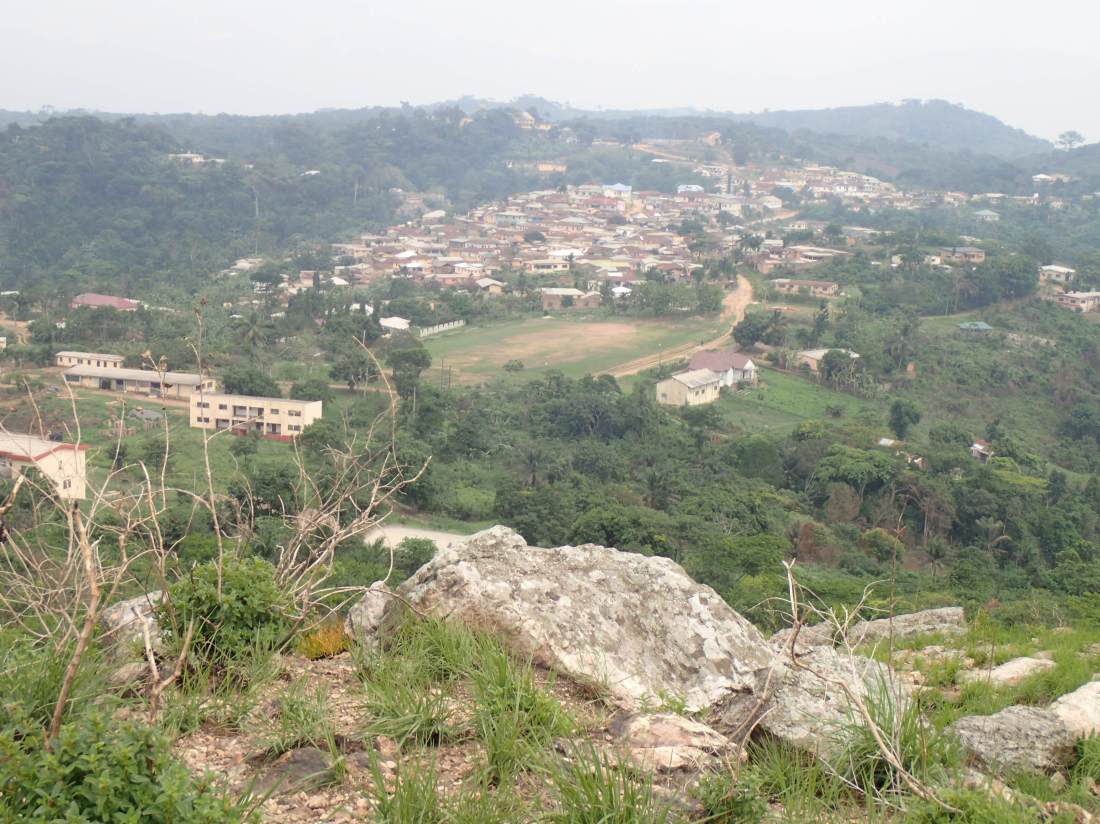
We go back to the visitor center to drop the guide off and pay for our guided trip. In Ghana this always involves signing into a large ledger, which asks for way too much unnecessary information, and paying a nominal amount. We hop back into the car and drive back down the mountain and our next stop is Ho for lunch. Since all we did in Ho was eat lunch and drive through the city I cannot comment too much on what actually goes on there. It is significantly less busy than Accra and fairly small city with less than 100,000 people. Our lunch took a long time to get to us though so it did have that in common with lunch out everywhere else in Ghana.
Back on the road, and the roads past Ho were definitely both the best and worst along the way — more potholes, more obstacle course driving intermixed with some smooth roads.. The further out of Ho we got the fewer towns, cars and people and the more tropical vegetation. We pass through several small villages along the way and see a few pig and chicken farms. As we get very close to our destination we pass through a small village with a huge sign proclaiming, “Open Defecation Free Town”. This is no joke. With less than 40% of people in Ghana having access to a toilet you can understand why this is actually a real problem here. It is nice to see these small villages working towards a cleaner, safer place for the people to live, but it didn’t stop me from wanting to take a picture (I refrained). About 10 minutes later (after about 6 hours in the car) we pull into Tagbo Falls Lodge.
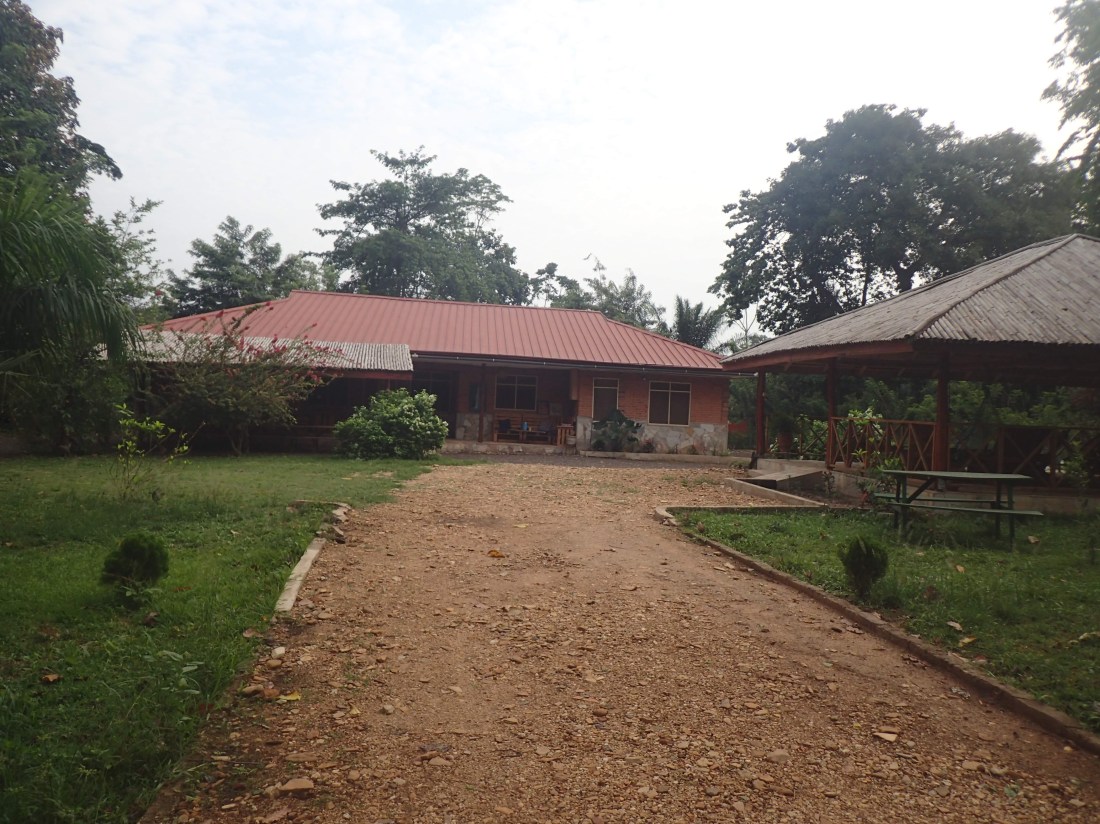
We are immediately greeted by Philomena when we arrive. She is the cook and manager of the property. The lodge is a bit of an oasis set back from the road (which doesn’t have much vehicle traffic anyway) surrounded with lots of greenery and large trees with a few chickens running around. There are just a few rooms and no AC but the ceiling fans are adequate and there is warm water for the shower if you remember to flip the switch for the water heater which is outside of our room. The system for buying beverages is basic in that we can drink whatever we want out of the refrigerator and just write it down on a slip of paper and then we are charged at the end. We are tired when we arrive and take a nap in the quietness of the place. It is lovely. After the snooze, I go for a short walk up the road to check out the village, Liati Wote, and just as I am coming back a young man approaches me and asks me, “Where is the mountain?” I am pretty sure I cannot be mistaken for a local but whatever. I point straight up the road at a mountain and tell him, “I assume right there.” He goes on to tell me that he walked from Accra to there (remember it took us 6 hours in the car!) to raise awareness about sanitation and climate change and it has taken him 4 days. He tells me his name is Malik. Malik goes along his way and it is getting dark so I hope that he is not trying to climb the mountain tonight. At dinner we discover that there are only two other people staying at the lodge — a mother and daughter from Belgium. The daughter is living in Accra for 6 months doing an internship at a moderately priced hotel on the outskirts of Accra. The hubster can speak Flemish, but I cannot so I am lucky that they both speak English — the daughter incredibly well without a hint of an accent. Dinner is family style and simple but very good. We head back to our room early and despite no AC and the heat I am quickly able to fall asleep only to be awoken by a pounding rain storm with thunder and lightning that lasted about 2 hours.
The next day starts early as we planned to climb to the top of the highest mountain in Ghana, Mt Afadjato, and we have agreed with our driver that the guide will meet us at 6:30 AM before it gets too hot. The rain has completely stopped and it is overcast and somewhat cool for Ghana. Our guide for the day, Daniel, comes while we are still eating breakfast but kindly waits for us and chats with the staff at the lodge while we finish breakfast. I don’t see a car anywhere and realize we are walking from the lodge to the mountain. We walk up the road, meander through the village until we come to a dirt path. We come to a fork in the trail and Daniel explains that we will be taking the path to the left and we ascend. Straight up. Really, I think that this might be the steepest trail I have ever been on. Luckily even though it rained hard last night, the trail is not slippery — just really, really steep. I am digging the hike and the challenge until I turn around and see the grumpy look on hubster’s face. Unlike me he doesn’t exercise outside much – he is much more of a “go to the gym and turn on the AC” type of guy in Ghana. He was not enjoying this much. Oh well, we keep going. There are a few places that have cables to help you along the way and some adorable encouraging handmade signs that tell you when you are ¼, ½ and ¾ of the way there. We only see a couple of other people along the way and the trail is pretty clear of litter (this is very unusual for Ghana). It takes us less than an hour and half to get to the top of the mountain. And here we are:
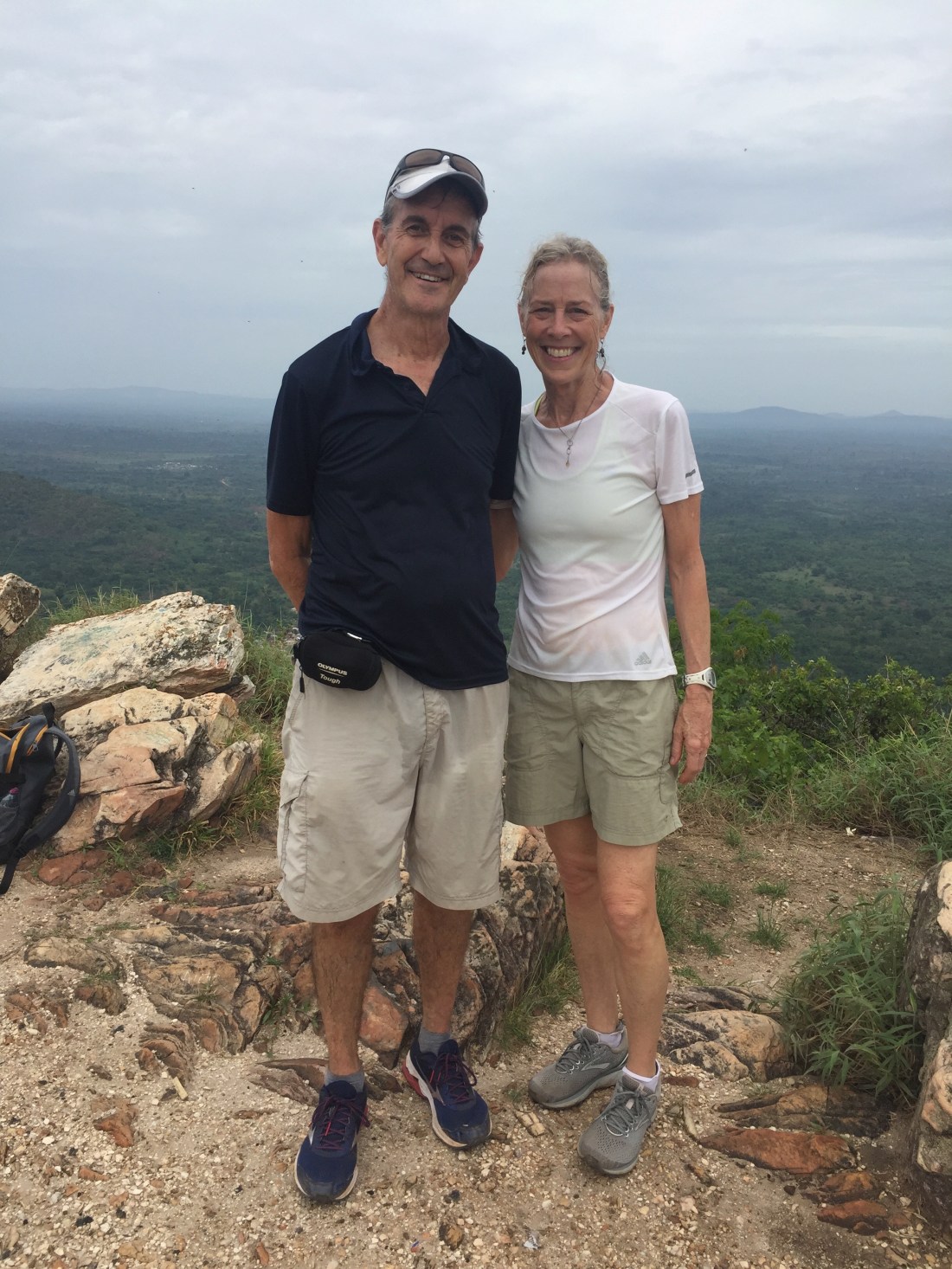


We sit at the top for awhile enjoying the views and have water (mandatory) and a snack. Daniel points out Tagbo Falls below. After this short break, we all start to scurry down the mountain and who is in the front? The hubster. That guy is like a horse going back to the barn downhill. We quickly make it back to the bottom and when we reach the fork again we take the other trail which leads to Tagbo Falls. Daniel assures the hubster that the trail is flat and in 45 minutes we arrive here:
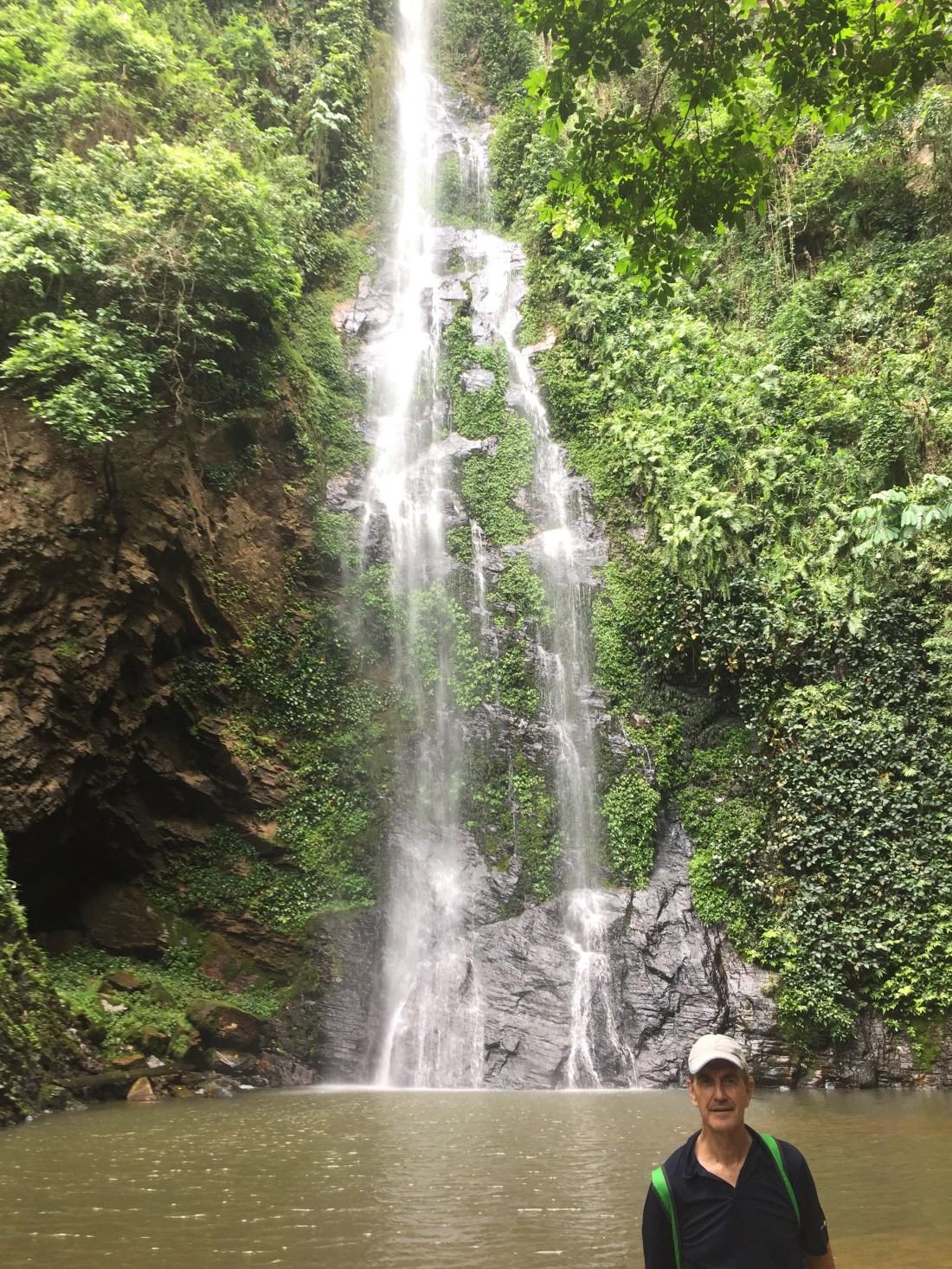
Since it is the end of the dry season here there is not as much water as usual in the pool below (nor in the falls). I dip my feet in but don’t go for a swim as it is not very deep. Daniel tells us we must come back in the rainy season when the falls are 6 times the size they are now. We head back to the lodge and we run into my new friend, Malik, with a group of about 10 people just starting to make their way up the mountain. We stop and take photos and I give Malik my Ghana phone number to send me the photos (the hubster cannot believe I do this). We are back before noon and we shower and eat lunch and spend the rest of the day lazing around the lodge reading. We are now the only people staying there as our Belgium ladies have left to head back to Accra. We are deeply grateful for the peace and serenity of the afternoon there.
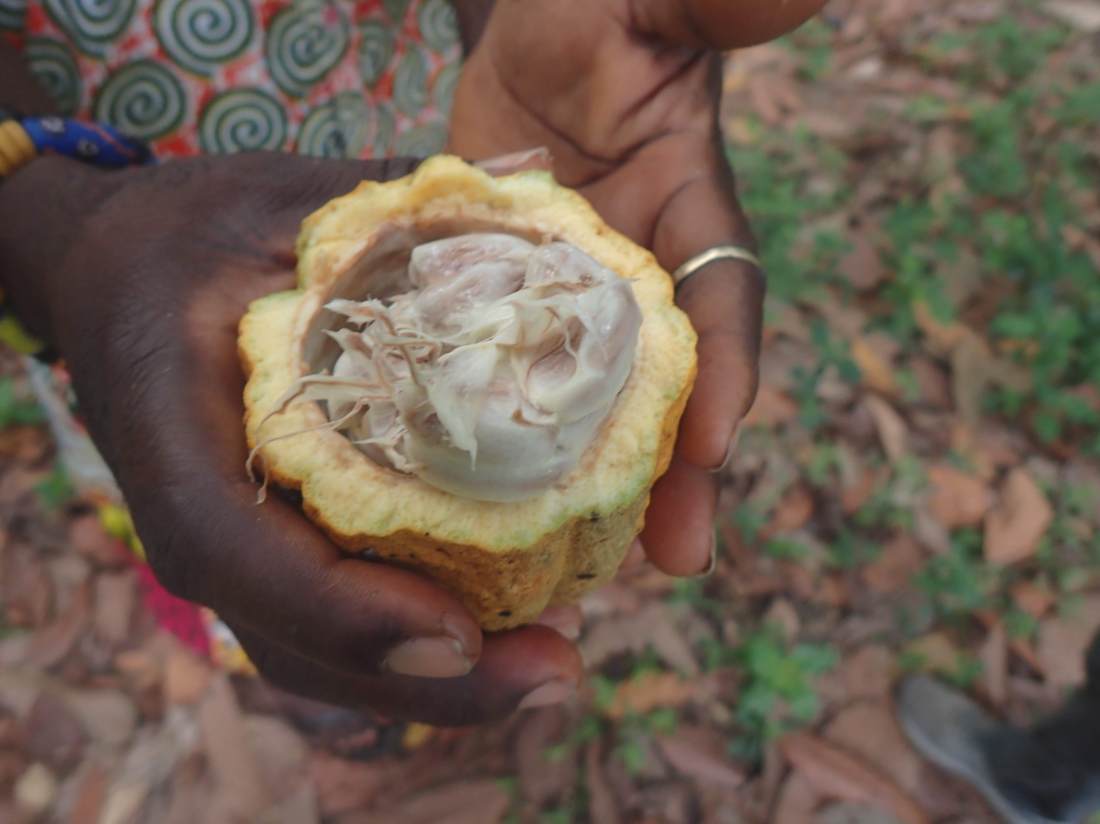
The next morning we have agreed to go for a little adventure with Daniel and watch the locals make palm wine and distill gin. This has to be done early in the morning since that is when they tap the palm trees. This is something to do with the sweetness of the sap when it is cooler outside (or something like that) . So at 7AM we leave from the lodge and walk a bit through the village and then take a path through the jungle. We can hear various groups of locals in the thick of the jungle talking and laughing. The path is lined with cocoa trees and Daniel stops and picks a cocoa pod and opens it up and we suck on the sweet seeds inside – it tastes nothing like chocolate. Eventually we come upon a group of 6 or 7 men and these are our “guys” that are going to show us how they make the palm wine. Unfortunately here in Ghana they chop down the trees to extract the sap. Other places, like Saõ Tomé, which we also recently visited, leave the trees standing so you do not kill the tree to make the wine. There is already a downed palm tree with a large hole cut into it. It looks like this:
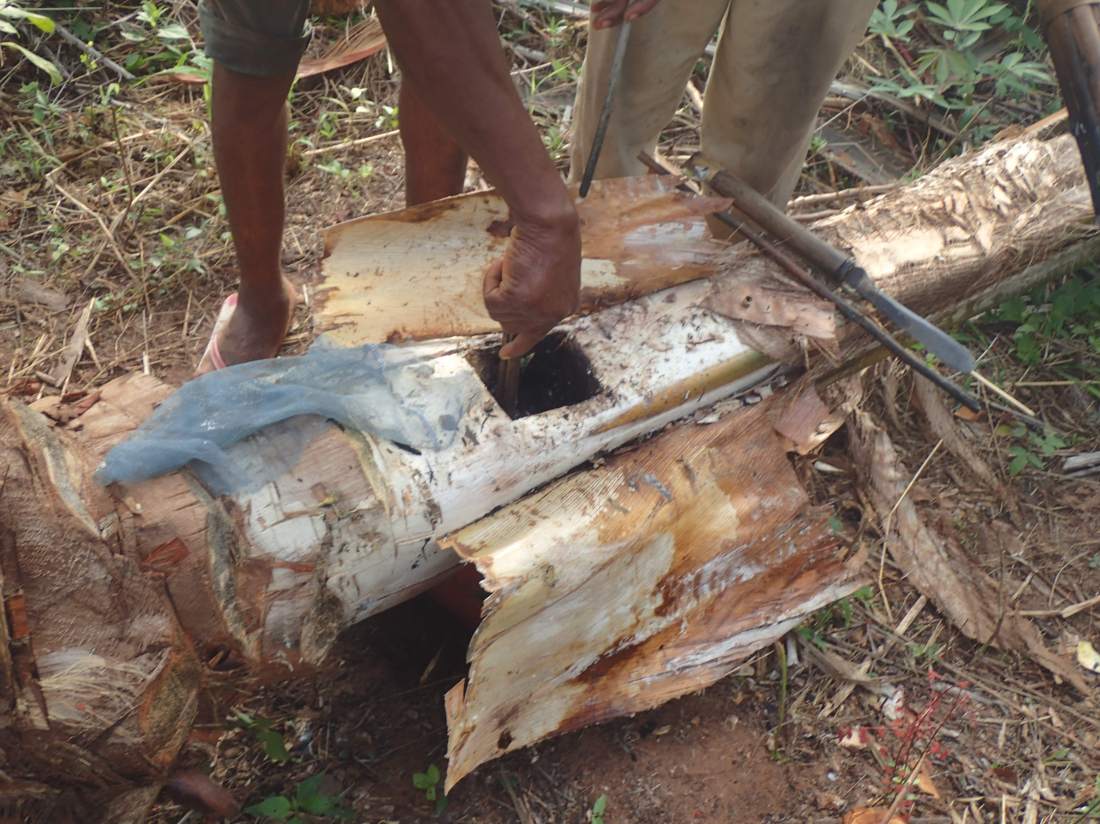
This large hole has a smaller hole in the bottom for the sap to drain out of the tree but first they take a lighted torch (made from wood) and heat up the area to speed up the flow of the sap. Then they put a container under the hole to capture the sap and just sit and wait as the container fills. It can take several days for the containers to fill. Then all this is dumped into a barrel and stored there and allowed to ferment. Some of this is further distilled and it made into gin. We tasted both the wine and the gin and at 7:30 AM with no breakfast the alcohol immediately went to my head (one of the crew is “tasting” the gin along with a bottle of Guinness). We politely declined to drink more with them but I thought both were surprisingly good.


We do a brief tour around the village with Daniel. We visit the local school which is in pretty good shape but lacks desks and chairs and see all the churches preparing for Palm Sunday. After being in garbage-filled Accra it is refreshing to see how clean the village of Liati Wote is — no plastic bottles and bags strewn all over. Daniel lives in the village and as we walk along when he picks up what little trash he sees as do we. Every little bit helps. The other missing thing here is noise. Very few cars and for the first time in days I don’t hear any honking. The village is small – only about 1000 people live here (yet they have 7 churches) so our tour is finished quickly and we head back to the lodge for breakfast and to pack for our trip back to Accra. We are not finished with our day yet by any means.
Our first stop after we leave Tagbo Falls lodge is Tafi Atome. The people here live in harmony with the mona monkey. I had heard and read about this place before and was encouraged not to feed the monkeys. So what happens as soon as we get there? We feed the monkeys. The hubster did it first — he held an unpeeled banana in his hand and the monkey jumped on his arm, peeled the banana and ate it all in about 10 seconds! Both of us were a little freaked out when it got down to the nub of the banana so we just dropped the remaining bit of the banana and the monkey jumped off to get the rest of the banana. Despite reassurance from the guide that these monkeys do not bite I was not quite confident that they would know the difference between the banana and my hand when it got down to it.
We spend about a half hour at Tafi Atome and then we take off back towards Accra. A friend recommended that we stop at a pottery place along the way and I mention this to the driver. He knows of the place but has never been there but has a general idea where it is. We are traveling through small communities and come upon a little larger village and the driver stops to ask directions to the pottery place from a woman running a shop alongside the road. She starts saying there is one this way and that way and a few more over there. I can see the driver wondering how there could be so many POTTERY places around until he finally realizes she thinks he is asking for a POULTRY place (as you might recall we passed several chicken farms on our way). Anyway, finally we get a general idea of where this place might be and get into the town and the driver stops again at an NGO that he knows of to ask if anyone there knows where the pottery shop is. While there he runs into a young woman whom he met before because he was the driver for her and her parents when they came to visit Ghana a few months ago. It is a small world. They also give him general directions and it turns out we are close. We see the sign for the “Pottery Shed” and turn off the main road onto a dirt road and run right into a Palm Sunday procession after church. We stop. The driver gets out and asks one of the women if she knows where the pottery shed is. The next thing we know she is pulling another woman out of the procession who happens to be…the owner of the pottery place. Of course. This is Ghana and this is how things work here. She rounds up two other ladies who work with her and we all walk down to the pottery shed together.
The ladies are friendly and do not rush us and take the time to explain how they make the pottery. They make the pottery and fire it in the kiln and they remove the pieces while they are still hot and bury them in the soil. The smoke/smoldering creates beautiful black pottery that is not painted in any way. It really is beautiful. I buy several votive candle holders, small dishes, a large cooking dish, a spoon holder and the hubster is worried that I am spending too much money until he sees the bill — which amounts to about $60 US. We leave happy that with a little help from many people we were able to discover this gem.


We leave the pottery shed and decide to not make any more stops along the way — we are still a good 4 hours from Accra. So, we continue to weave back and forth over the rough roads, back through Ho and we and all our pottery arrive intact and safe back home. The hubster and I are both happy to be home but very happy to have the weekend getaway to experience another side of Ghana that you would never get in the city. A memorable journey for sure!


The pottery really is spectacular. Great post!
LikeLike