

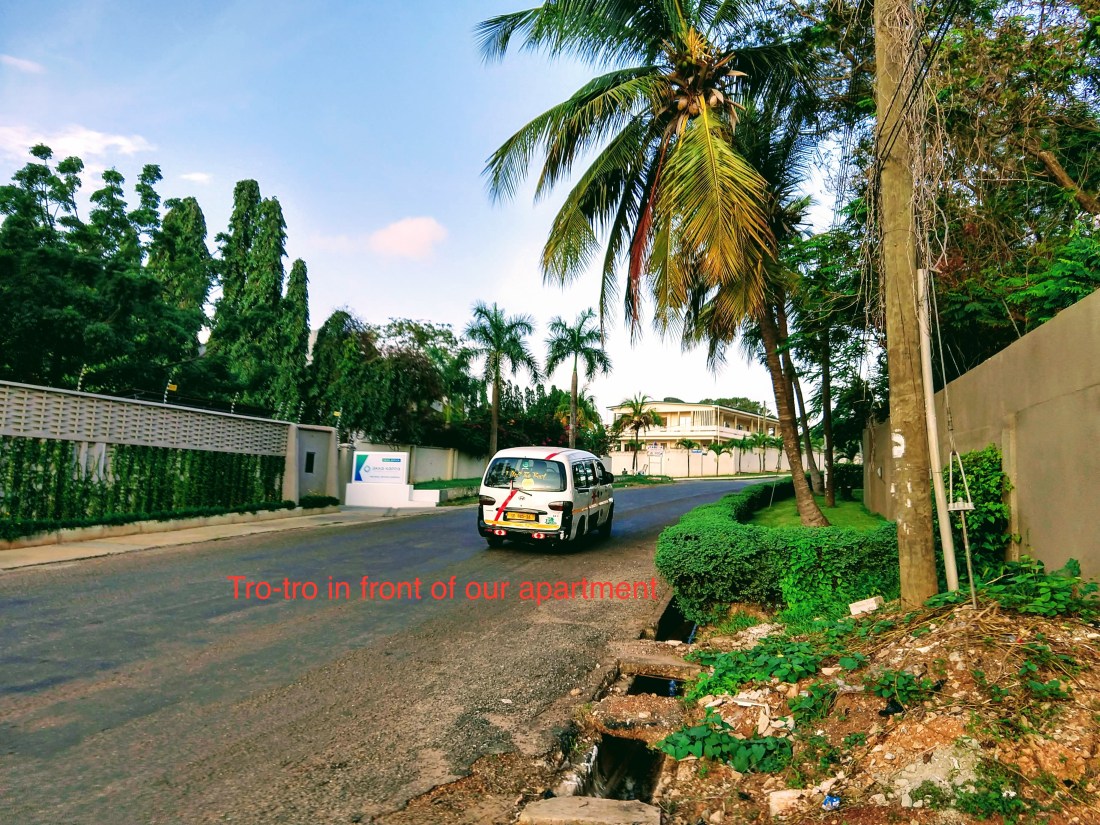
 We don’t have a car here in Accra so I spend part of my day, everyday, trying to calculate how I am going to get from point A to point B and back the most efficiently. I am surprised that going to the grocery store or to French class can be an adventure just to get there. They are several options for travel within the city: walking, Uber, taxi, tro-tros, shared taxi and private car. Some are reliable, some semi-reliable, and others just don’t seem like a good option for various reasons.
Should I walk? This is highly dependent not on just how far it is but how hot it is outside and how much traffic there might be and whether there is enough room on the side of the road to walk. Also, walking here is not for dawdlers. Seriously, you will die if you dawdle. Every pedestrian I see runs across the street. Even when a car has stopped to allow you to cross, you run, as fast as you can – like your life depends on it (because it does). In some ways I wish Americans could heed to this in the US – being an impatient American I do get a bit irked when in the US able-bodied individuals lollygag across the street when I am in my car. NEVER. WOULD. HAPPEN. HERE.
Should I take an Uber? Yes Uber is here and thriving but not always reliable. In fact, more often than not, it takes 2 or 3 tries to call up an Uber before one actually shows up to pick you up. Cancellations while they are “on their way” are common even when the driver is texting you that they will be there soon or you watch your Uber car on the little map that the app provides and you see it make a U-turn away from you and the time to reach you increases by a minute, then two, then five, then you get a cancel notice. I find this so confusing and a bit funny. Well, not really funny when I have a load of groceries and am trying to get home before everything melts or spoils in the heat. I have resorted to measuring some of my days by my Uber experience – get an Uber on the first try AND he (no she Uber drivers that I have seen) had a working seat belt in the back seat – that is a thumbs up kind of day.
Should I take a taxi? This involves 2 important issues: 1) you must not only know where you are going but how to get there. Street names and addresses have little to no meaning here – you must know landmarks (mine is always “I live near the Koala Airport market” and 2) you have to feel up for bargaining since there are no meters and the price is ALWAYS negotiable. I will overpay for a taxi just so I can get home quickly. Also, when I say overpay I mean paying the equivalent of under $4 US dollars instead of $2 or $3. Can’t get too upset at those prices. Taxis also seem to lack working seat belts in the back and I have yet to be in an Uber or taxi with air-conditioning or maybe they have it and just don’t turn it on.
Speaking of taxis…The first week we were here we noticed (hard not to since about 50% of the vehicles on the road are taxis) every taxi that passed us while we were walking tooted their horn at us. The hubster and I thought this was maybe a sign that we were walking too far into the road or that they thought we should not be walking and we should jump in. Well, we come to find out honking here means: 1) I see you and just in case you really want a ride here I am 2) I am turning the corner so if you are crossing you better run (see above) or wait until I have turned 3) I see a taxi going the other direction, “Hey there, other taxi!” or 4) I see someone pulling out and I want them to know I am here. While out walking, taxi drivers will stop or slow down and ask, “Where are you going?” They just want to know if I want a ride and when I wave them away they look at me and also gesture with an upturned hand meaning, “Why would she walk when she could get a ride?” Not an unreasonable thought especially when I notice even the back of my hands are sweating.
So this all leaves me with the other 3 options – tro-tros, private car or shared taxi. I have yet to take a tro-tro. Tro-tros are minibuses that are public transportation. They are the most common and cheapest form of transportation for Ghanaians. There are usually pretty rickety looking, spew a lot of black smoke, have religious or other sayings on the back windshield (i.e. “Yours is coming”, “Nowhere good”, “Fear women and save your life”) and I have often seen the back gate and the sliding door held closed by rope. They are usually stuffed with people and what they are carrying and when someone gets out it looks a bit like a small amount of toothpaste being squeezed out of the tube. That all being said, I have not managed to have enough courage to get in one…yet. Hiring a private car is a luxury here and it is nice to do when you are traveling a bit out of the area or you have a lot of errands to run and don’t want to keep calling for an Uber or taxi. I probably never will experience a shared taxi – this is when a taxi will pick up other passengers along the way. It is a lot cheaper than a regular taxi but doesn’t seem to be the safest or most efficient way to go especially since I seem to have lots of other options.
There have been other highlights in the first month here included a trip up the coast with the hubster’s colleagues, including a visit to Kakum National Park where we walked along the Canopy Walkway, bridges suspended 30 meters above the ground; we have experienced several electrical outages – one lasting almost 2 full days (but we have a generator so don’t feel too sorry for me). I started taking French classes 5 days a week and I am the oldest student by over 20 years and I’m also taking Twi (the local language) once a week. We learned how to bargain at the market in Twi last week – somehow bargaining in a language other than English is empowering rather than intimidating, go figure. Yesterday I watched a movie being made at my favorite coffee shop around the corner from our apartment with the famous Ghanaian actor, Prince David Osei and my favorite waiter got a bit part in the movie. So life here is not just about wishing for a timely Uber ride and a seat belt, but I’ll take those things any day. MΣhunu wo akyire.
 Hubster on canopy walkways trying to not look frightened.
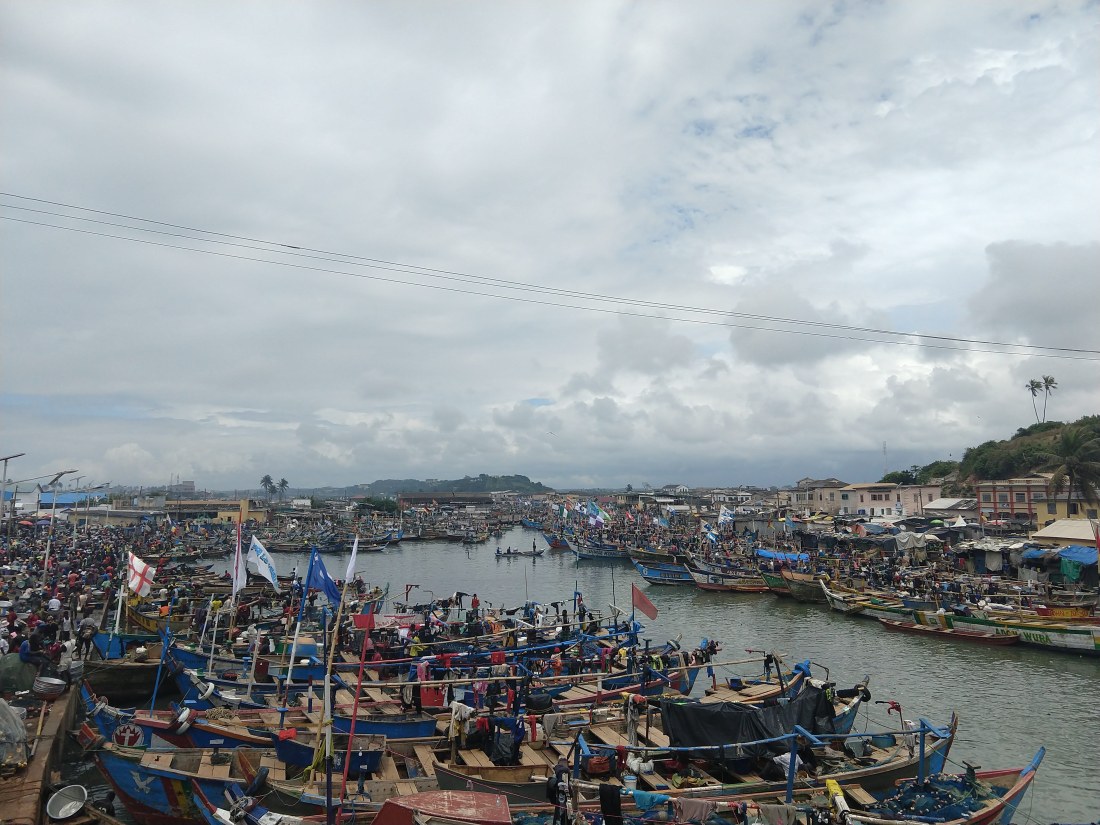 Elmina – fishing village up the coast.
 Actually officially we arrived 12 days ago, but the first week was a bit of blur with settling in, attending an orientation with hubster for his work (this is mostly a “how to stay safe and healthy in Ghana course”), running around trying to figure what you need for your apartment and where the stores are and is it better to take an Uber (yes, they have Uber here, more on that later), a taxi or get a private driver.
 A word from my guest columnist, the hubster, George.

 Aptos To Accra